Motorcycle Panniers vs Soft Bags for Wet Climates
 kristina estep
4 min read
August 1, 2026
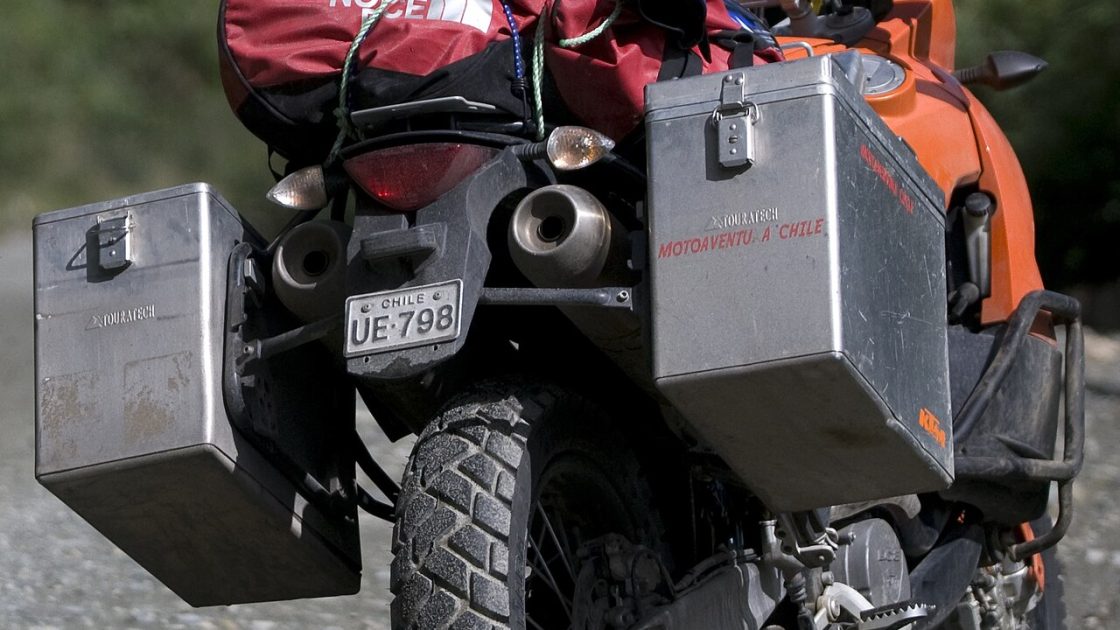
Hard panniers are sold as the touring upgrade, and in sustained rain they are not automatically the drier option. Water gets into a hard case through the lid seal and stays there, while a soft bag with a roll closure sheds it.
The lid seal problem
A hard pannier relies on a rubber gasket and a latch that compresses it evenly. Once the gasket hardens or the case is slightly distorted, water tracks in along the top edge.
Hard cases also hold water once it is inside. A pannier with a litre of water in the bottom soaks everything sitting in it, and the pannier itself takes days to dry.
Check the gasket before a wet trip. A thin smear of silicone grease keeps it supple and improves the seal more than a new latch does.
Roll-top soft bags
A roll closure works by folding the fabric over itself several times, so water has to travel a long path to get in. It needs no gasket and no latch, and it does not rely on precise alignment.
The weak point moves to the seams and the base. Welded seams and a reinforced base make a soft bag genuinely waterproof rather than water-resistant.
Dry bags inside a soft bag are the belt-and-braces answer, and they cost very little. A dry bag also means that if the outer gets wet, the contents do not.
Security and convenience
Hard cases lock and hold their shape, which matters in a city and when the bike is parked at a ferry terminal. Soft bags attract a slash with a knife and cannot be left safely anywhere.
Hard cases also survive a drop without spilling. A soft bag that falls off at speed distributes its contents along a motorway.
Quick-release mounts make hard cases convenient for daily use, and that convenience is the real reason tourers choose them.
Weight and the bike’s behaviour
Hard cases are heavy empty and sit wide, which affects filtering and crosswind stability. Soft bags are lighter and can be narrower, and they squash when the bike leans in a tight space.
Wide panniers also change the aerodynamics at speed and can produce a weave on a light bike. Narrow soft bags avoid that entirely.
Check the total width with the cases fitted before committing to a route through city traffic.
Durability in the real world
Hard plastic cases crack at the mounting points after a few drops, and the crack is often invisible until the case departs. Aluminium cases dent and stay usable.
Soft bags abrade where straps rub the paint and where the bag touches the exhaust. A heat shield and a protective film on the panels fix both.
Zips are the failure point on soft luggage. A zip that fails in the rain leaves the bag open, which is why roll closures are preferred for the main compartment.
Choosing for a wet climate
For a rider who tours in constant rain, roll-top soft bags with dry bags inside are the simpler and drier system. For daily use with occasional trips, hard cases win on convenience.
The combination that works for many riders is a hard top case for the lockable items and soft side bags for clothes. Each handles what it is good at.
Test the setup in a car wash before a trip. Ten minutes with a hose reveals leaks that a day of drizzle will hide.
Hard cases are convenient and soft bags are drier. In a wet climate the deciding question is not which looks like touring equipment but which keeps the contents dry after six hours of rain.
kristina estep
Logs parts and riding gear against distance and weather. Writes from the workshop, not the press launch.